TL;DR: Most job seekers now use AI somewhere in their search, so a polished AI draft no longer sets anyone apart. Recruiters are seeing thousands of applications that sound the same, and employers are adding identity and skills checks because of AI-assisted fraud. The candidates who win use AI for research, structure and practice, then rewrite everything in their own words with real numbers from their own work. Never let AI invent skills, answer live interview questions for you, or apply to jobs on its own. This guide shows where AI helps, where it hurts, and why real work, like a paid work trial, is becoming the test that matters most.
Key takeaways
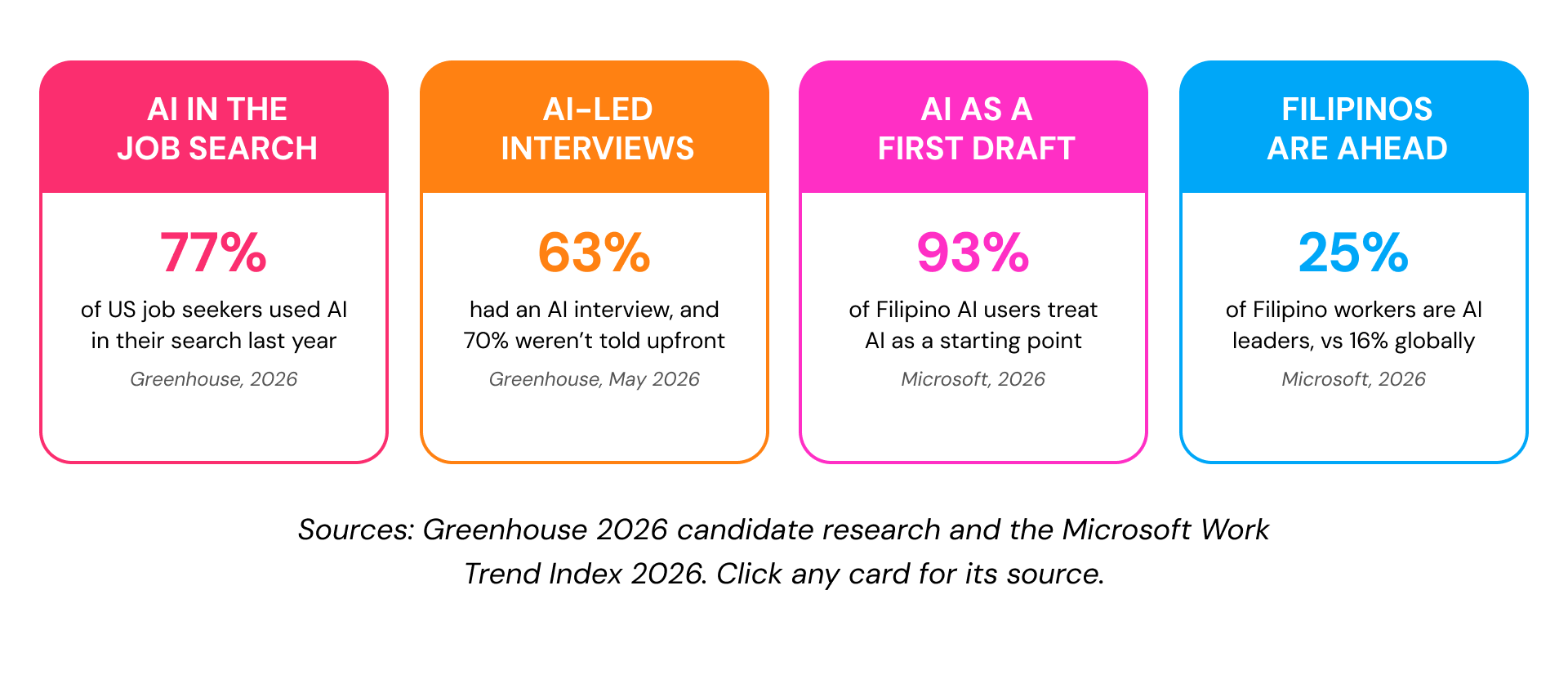
- 77% of US job seekers used AI in their search in the past year (Greenhouse 2026 Future of Hiring Candidate Report).
- 60% of US job seekers have changed, or considered changing, how they write so their application is not mistaken for AI (Greenhouse).
- Filipino workers are ahead: 25% qualify as "Frontier Professionals" who build their work around AI, against 16% globally (Microsoft Work Trend Index 2026).
- 93% of Filipino AI users treat AI output as a starting point, not a final answer (Microsoft).
- 63% of job seekers have now been interviewed by an AI, and 70% were never clearly told upfront (Greenhouse, May 2026).
- Gartner predicts that by 2028, one in four candidate profiles worldwide will be fake (Gartner), which is why employers are checking harder.
- The safest workflow: write it yourself first, then let AI edit. Specific results beat polished wording every time.
Why polished AI applications stopped working
AI is now a normal part of looking for work. You can research a company in minutes, turn a messy work history into a clean résumé and rehearse an interview at midnight. Filipino professionals adopted these tools earlier than most: back in 2024, 86% of knowledge workers in the Philippines already used AI at work, against a global average of 75% (Microsoft and LinkedIn, 2024).
The catch is that everyone else has the same tools. LinkedIn was receiving around 11,000 applications per minute in 2025, up 45% from the year before, with AI tools part of the reason (eWeek, citing The New York Times). When every application is polished, polish stops working as a signal. Recruiters start looking for the things AI cannot fake: specific results, consistent stories and real work.
That shift is good news for capable candidates, especially Filipino professionals applying for the specialist roles overseas companies now hire for. You do not need to stop using AI. You need to use it for the right jobs and keep the rest for yourself.
Use AI to research, not to pretend
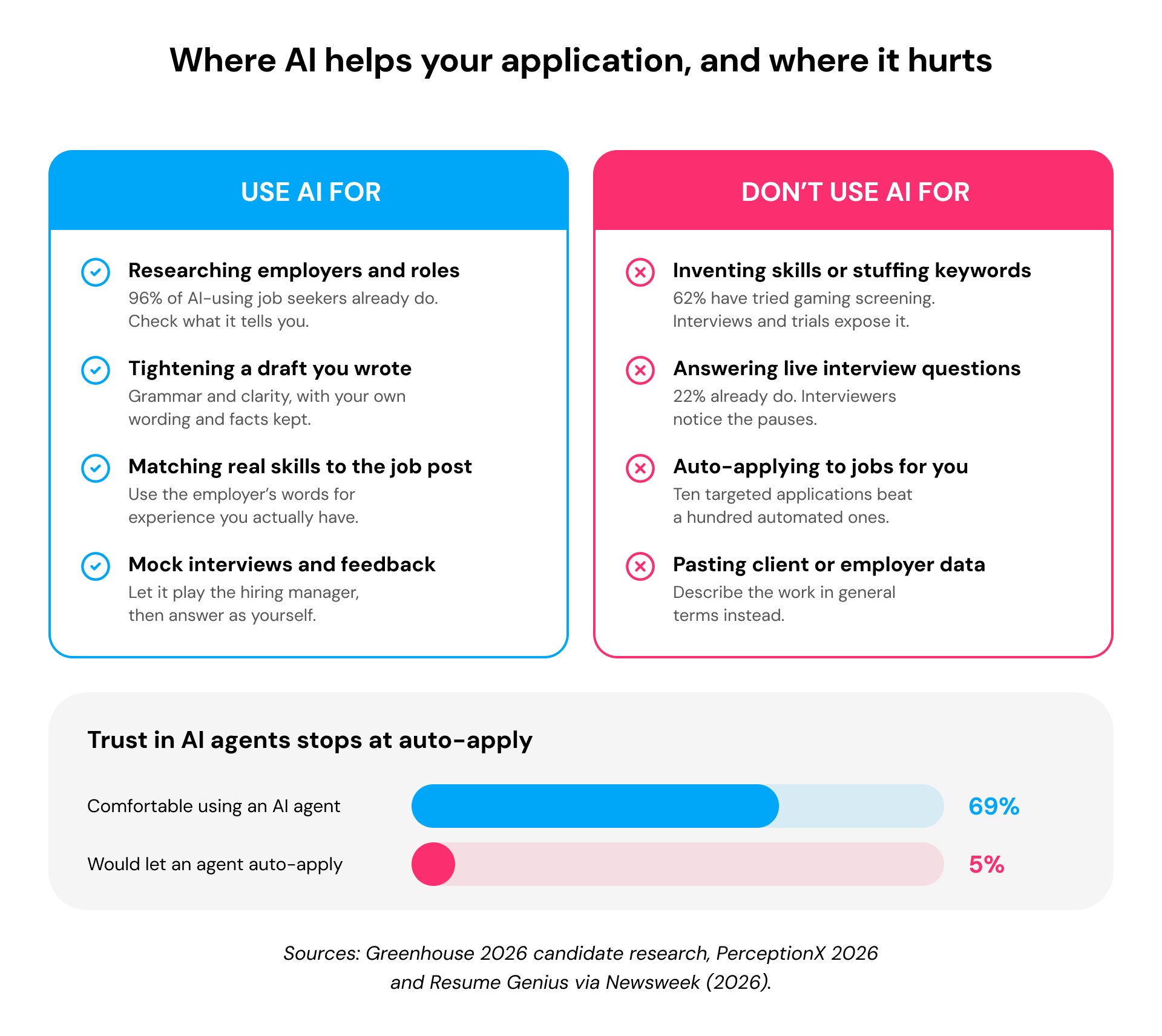
Research is where AI helps most and risks least. In a 2026 survey of AI-using job seekers across seven countries, 96% had used AI to research employers, roles or interview prep (PerceptionX, 2026).
Good research prompts look like this:
- "Summarize what this company sells, who its customers are and what changed in the last year."
- "What does a typical week look like for a remote executive assistant supporting a US founder?"
- "Which skills in this job description are must-haves and which are nice-to-haves?"
Then check what it tells you. The same PerceptionX survey found that 58% of job seekers had caught AI giving inaccurate information about an employer. Confirm anything important on the company's own website, LinkedIn page or recent news before you mention it in an application or interview.
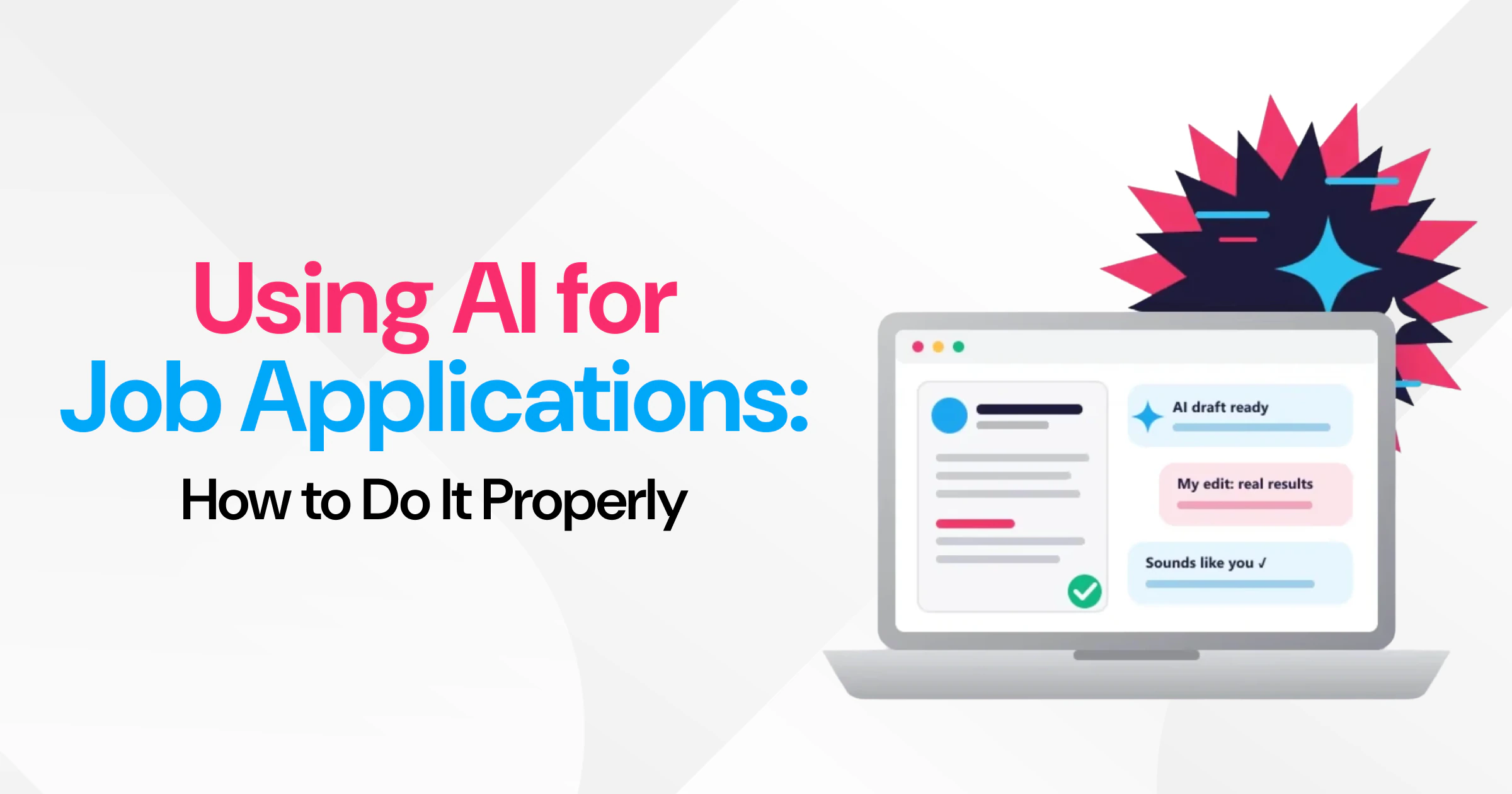
Write it yourself first, then let AI edit
The safest workflow is the one some AI companies now recommend to their own applicants. Anthropic first asked applicants not to use AI at all during the application process (Fortune, February 2025). It has since relaxed that rule and now asks candidates to draft their résumé, cover letter and answers themselves, then allows them to use AI to refine those drafts (Fortune, July 2025).
That order matters. If you start with your own draft, the facts, examples and voice are yours, and AI only tidies them. If you start with a generic AI draft, you end up editing a stranger's application.
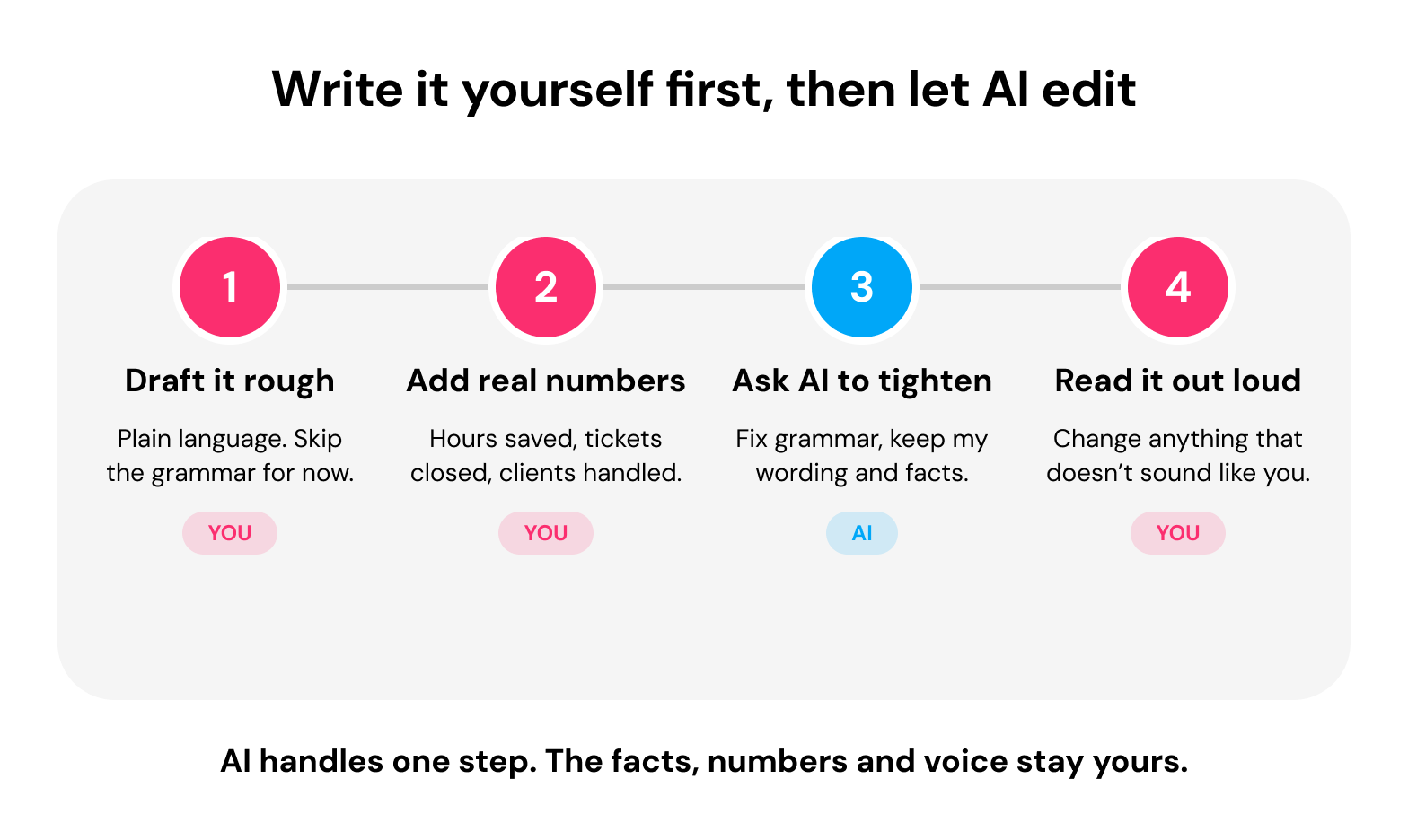
A simple four-step process
- Write a rough version in plain language. Do not worry about grammar.
- Add one real number to each achievement (hours saved, tickets closed, clients handled, revenue supported).
- Ask AI to "tighten this for clarity and fix grammar, but keep my wording and facts".
- Read the result out loud. Change anything that does not sound like you.
Recruiters are noticing sameness more than AI itself. Greenhouse found that 60% of US job seekers have changed or considered changing how they write to avoid sounding like AI. The fix is not to write worse. It is to write more specifically.
Before and after: what "AI properly" looks like
| Application line | Generic AI version | Properly edited version |
|---|---|---|
| Summary | "Results-driven professional passionate about delivering excellence in fast-paced environments." | "Executive assistant for two US founders for three years, managing calendars across PHT and EST." |
| Achievement | "Streamlined operations and improved efficiency across the organization." | "Built a shared inbox system that cut response time on client emails from 24 hours to 4." |
| Skills | "Expert in project management, data analysis, marketing, design and coding." | "Daily: Asana, Google Workspace, HubSpot. Learning: Looker Studio dashboards." |
| Cover letter opening | "I am thrilled to apply for this exciting opportunity at your esteemed company." | "Your post mentions onboarding 20 new clients a month. I handled a similar intake at my last role." |
| Interview answer | A memorized AI paragraph about "leveraging synergies". | A two-minute story: the problem, what you did, the result, what you would do differently. |
Do not game the screening system
It is tempting to use AI to stuff a résumé with every keyword in the job post. Many candidates already do it. Greenhouse found that 62% of US job seekers tried tactics to get past automated screening, including adding skills they do not have and hiding text meant for AI reviewers (Greenhouse, October 2026).
This backfires in three ways:
- Interviews expose it. If you list a tool, expect to be asked to use it or explain how you used it.
- Trials expose it faster. In a 30/60/90-day paid trial you do the real work from week one, so missing skills show up quickly.
- It looks like fraud. Employers are on alert. Gartner reports that 6% of job seekers admitted to interview fraud, such as having someone else interview for them.
Use AI to match your real skills to the job's language instead. A well-written job description already tells you what the employer values most. Ask: "Which of my experiences best match this job description, and what words does the employer use for them?" That keeps you honest and still helps you get past the filters.
Practice interviews with AI, then answer as yourself
AI is a great sparring partner. Ask it to play the hiring manager, give you ten likely questions for the role and push back on vague answers. Record yourself, then ask AI where your answers lost focus.
What you should not do is have AI answer for you during a live interview. Resume Genius found that 22% of US job seekers already use AI during real-time interviews (Newsweek, 2026). Interviewers notice the pauses, the eye movements and answers that sound like a textbook.
Why remote employers are checking identity
Remote employers are tightening identity checks because of fraud. US tech leaders have described fake job seekers flooding remote roles (NBC News, 2025). In one case, an Arizona woman was sentenced to 102 months in prison for running a "laptop farm" that helped North Korean IT workers using stolen US identities defraud 309 US businesses (US Department of Justice, 2025). Gartner expects fake candidate profiles to contain material identity misrepresentation (Gartner HR Symposium, 2025), so identity checks are becoming standard. Honest candidates benefit when they can show they are exactly who they say they are.
Expect more AI on the employer side too. 63% of job seekers have now done an interview run by AI. Treat these like any other interview: clear answers, specific examples, a quiet room and a stable connection.
Protect your data and other people's
Free AI tools are convenient, but be careful what you paste into them. Do not upload a former employer's client lists, internal documents or anyone else's personal details to write a better case study. Describe the work in general terms instead.
The Philippines' National Privacy Commission has already set out how the Data Privacy Act of 2012 (Republic Act No. 10173) applies to AI systems that process personal data, with expectations around transparency, accuracy and data minimization (NPC Advisory No. 2024-04). Overseas clients will expect you to treat their data with the same care, so showing good habits now is part of being hireable.
Also skip fully automated "auto-apply" agents. Even among candidates comfortable with AI agents, very few trust them with this job: 69% would feel comfortable using an AI agent, but only 5% would let one apply to jobs on its own (Greenhouse). Mass applications rarely beat ten targeted ones.
The bottom line
AI is now a basic job-search skill, and knowing how to use it well is worth showing off. The World Economic Forum lists AI and big data as the fastest-growing skills employers expect to need through 2030 (WEF Future of Jobs Report 2025).
The candidates who stand out use AI the way strong Filipino workers already do: as a starting point, checked with their own judgment. In the 2026 Work Trend Index, 65% of Filipino AI users named critical thinking as the most important human skill, the highest of any market surveyed (Microsoft). Let AI do the drafting and drilling, and keep the facts, the judgment and the voice your own.
How Hireable's paid work trial rewards real skill: Hireable is being built for exactly this moment. When anyone can produce a perfect-looking application, the fairest test is real work. Every Hireable match is designed to start with compatibility (work style and role fit), then be validated through a structured 30/60/90-day paid work trial. You are paid for the trial, you do the actual job, and the employer sees how you work, not how well a chatbot writes. If you use AI well in your day-to-day work, the trial is where that shows.
FAQ
Is it okay to use AI to write my résumé?
Yes, if you use it to edit your own draft rather than invent one. Start with your real roles, results and numbers, then ask AI to tighten the wording. Always check that every claim is true and that it still sounds like you.
Can employers tell if I used AI?
Most employers are not relying on AI detectors, but they do notice generic phrasing and claims that do not hold up in interviews. Greenhouse found 60% of US job seekers have rethought how they write to avoid sounding like AI. Specific, measurable examples are the best protection.
Should I use AI during a live interview?
No. It is usually obvious, it may break the employer's rules and it can look like fraud at a time when companies are checking candidate identities more closely. Use AI to practice before the interview, then answer in your own words.
Should I tell an employer I used AI in my application?
If the employer asks, be honest and explain how you used it, for example "I wrote my answers and used AI to check grammar and clarity". Some employers publish their own guidance on AI use in applications, so read the job post carefully and follow it.
What AI skills should I highlight to remote employers?
Highlight specific, practical uses: summarizing long email threads, drafting first versions of reports, building simple automations or checking data. Mention how you review AI output for accuracy. Employers want people who use AI to work faster without lowering quality.
About the author
By Juliana Carisle
Juliana Carisle writes about distributed hiring, Philippine outsourcing trends, and how lean global teams build compatibility-matched remote teams. Her work covers content systems, SEO, and the operating practices behind sustainable cross-border employment. Published through Carisle Media.
Hireable, the platform behind this publication, is preparing for its 2027 launch with compatibility-matched Philippine remote hiring and structured work trials built into the model. Waitlist members get early access. Click the "Join the waitlist" button above.