Key takeaways
-
Global BPO is projected to grow from $348B (2025) to $384B (2026) and reach $900B+ by 2035 (Precedence Research).
-
The Philippine BPO sector is expected to generate $38.5B in 2025 and ~$42B by 2026, contributing 9% of GDP (Data Bridge Market Research, KDCI).
-
The Philippines employs approximately 1.7M outsourcing professionals and holds ~15% of global BPO market share (VA Masters, GigaBPO).
-
Voice and CX services still account for 60-70% of Philippine BPO revenue, even as digital, IT, and back-office work scale fast (CX Centrica).
-
About 65% of enterprises now rely on outsourced processes, and gig-economy work is increasingly blended with BPO models (Global Growth Insights, Unity Connect).
-
Hireable connects US companies with compatibility-matched Filipino professionals using a 30/60/90-day trial structure, not a staffing or EOR model.
Philippine remote work, by the numbers
PH BPO 2025-2026 1.7M Filipino professionals employed in outsourcing Source: VA Masters, 2025 $38.5B PH outsourcing revenue 2025 (Data Bridge) 9% of Philippine GDP (KDCI) 15% of global BPO market share (GigaBPO) 60-70% PH BPO revenue from voice/CX (CX Centrica) Remote work has moved past the experiment phase. Over the last decade, it has reshaped how companies build teams, where they hire from, and how they price talent. The Filipino virtual assistant market and broader Philippines BPO sector are the clearest examples of this shift. What started as call center work in 2010 has become a $38.5B engine of Filipino remote workers supporting US, UK, and Australian companies across customer support, finance, marketing, engineering, and operations (Data Bridge Market Research, KDCI).
1. How big is the global outsourcing market in 2026?
The global business process outsourcing (BPO) market is expected to reach $384B in 2026, up from $348B in 2025. Looking further ahead, Precedence Research projects the market to climb past $900B by 2035, driven by enterprise demand for cost efficiency, digital transformation, and access to specialized talent (Precedence Research).
Global Growth Insights estimates that about 65% of enterprises now rely on outsourced processes as a core operating model, not a tactical fix. That figure has shifted the conversation. Outsourcing is no longer about cutting costs at the margins. It is about building scalable, distributed operations that can flex with demand (Global Growth Insights).
Why this matters for US founders If two thirds of enterprises are operating with outsourced teams, the question is no longer whether to hire offshore. It is which model fits how you actually want to build: a staffing agency, an EOR, a freelance marketplace, or a compatibility-matched hiring platform like Hireable.
2. Why is the Philippines leading the global BPO shift?
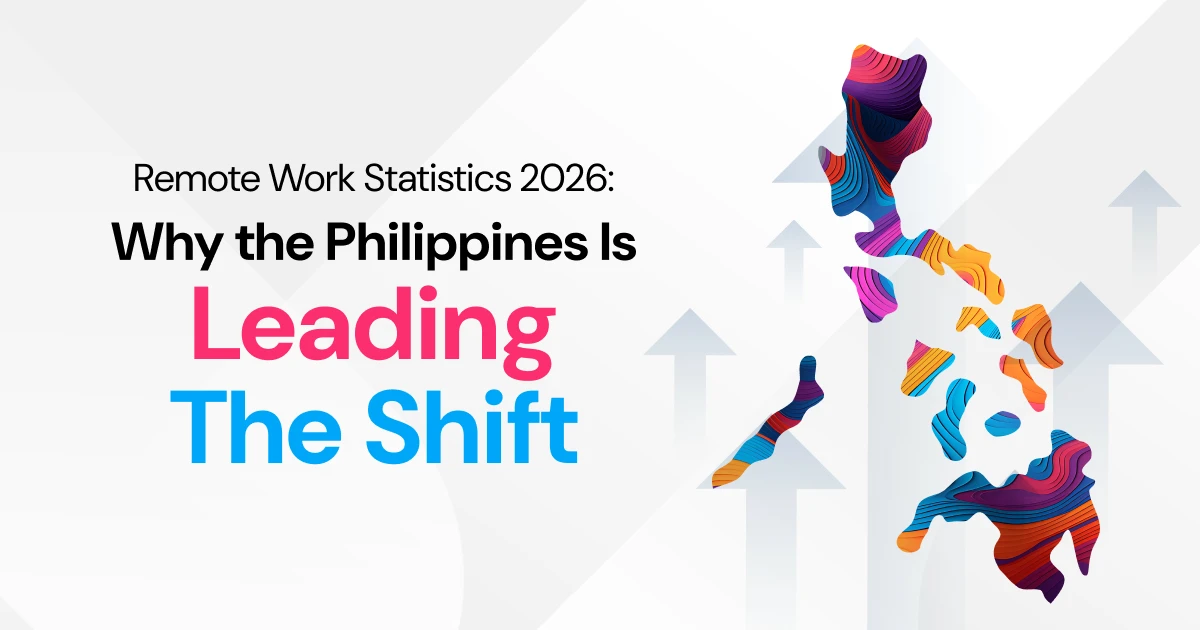
Within that $384B global market, the Philippines holds an outsized position. The country is expected to generate $38.5B in outsourcing revenue in 2025 and is on track for ~$42B by 2026, contributing roughly 9% of national GDP. Approximately 1.7M Filipino professionals are employed in the sector (KDCI, VA Masters).
That scale gives the Philippines roughly 15% of global BPO market share. Three structural advantages keep that share growing: English fluency built into the education system, a workforce trained for service work over decades, and time zones that overlap meaningfully with both US and Australian business hours (GigaBPO, Data Bridge Market Research).
15 years of growth: $9B to $42B

The Philippine BPO sector has grown from roughly $9B in revenue in 2010 to a projected $42B in 2026. That is a 4.3x expansion in 15 years, through a global financial crisis, a pandemic, and the AI shift. The base has held up because the talent base has held up.
3. What does the Philippine workforce actually do?
Voice and CX work still anchors the sector. Customer support, technical helpdesks, and inbound/outbound voice services account for roughly 60 to 70% of Philippine BPO revenue (CX Centrica). That is the legacy strength: English fluency, neutral accent, service mindset, and decades of operational training.
But the mix is changing. The fastest-growing categories are non-voice and digital:
-
Knowledge process outsourcing: data analytics, research, legal and finance support, healthcare admin.
-
IT and software services: QA, dev support, infrastructure, cybersecurity monitoring.
-
Creative and marketing: design, video editing, content production, paid media management.
-
Back-office and finance: bookkeeping, AP/AR, payroll, fractional finance support.
-
Executive and operations support: high-trust virtual assistants embedded into leadership teams.
This is the layer where most US founders meet the Philippines. They start with a Filipino virtual assistant or a single specialist hire, then expand into a small, embedded team as trust grows (GigaBPO, KDCI).
4. How is the gig economy changing BPO?
One of the more interesting shifts in the last two years is the blending of traditional BPO and gig-economy flexibility. Large BPO providers used to compete on scale: thousands of seats, fixed hours, long contracts. Independent Filipino specialists used to compete on cost and speed but lacked the structure to support enterprise clients.
That gap is closing. Companies are increasingly choosing models that combine the reliability of a structured engagement with the flexibility of independent professionals (Unity Connect, Data Entry India BPO, LinkedIn analysis on freelancer vs BPO).
Drivers behind the shift
01 Global BPO is booming The global BPO market is projected to reach $384B in 2026, on track for $900B+ by 2035 (Precedence Research). 02 PH is the global leader The Philippines holds roughly 15% of global BPO market share, anchored by its English fluency and CX strength (GigaBPO). 03 Enterprises lean on outsourcing About 65% of enterprises now rely on outsourced processes to stay lean, agile, and globally connected (Global Growth Insights). 04 Gig + BPO is the new model Companies increasingly blend gig-economy flexibility with structured BPO reliability for resilient, on-demand operations (Unity Connect, CX Centrica).
For a US founder, this matters because it changes what "hiring offshore" actually looks like in 2026. You are no longer choosing between a 200-seat BPO and a $5/hour freelancer. You can hire a single compatibility-matched specialist, embed them in your team, run a structured trial, and scale only when the fit is proven.
5. Freelancer vs BPO vs platform: which model fits?
Most discussions about Philippine outsourcing collapse three different models into one. They are not the same:
-
Independent freelancer hire: lowest overhead, highest variance, no infrastructure around the engagement.
-
Traditional BPO contract: structured and reliable, but often built around large seat counts and rigid contracts.
-
Compatibility-matched hiring platform: a single specialist matched to your work style, with a structured trial period and contractual protections, without the seat minimums of a BPO.
The third model is where Hireable operates. Each Filipino professional on Hireable is matched against the founder or hiring manager on work style, communication preferences, and role expectations. The structure is a 30/60/90-day trial with single-client commitment, not a shared pool (CX Centrica, Unity Connect).
6. Where is this all going?
Three signals worth tracking through the rest of 2026 and into 2027:
-
AI augments but does not replace the Philippine BPO base. Voice, CX, and knowledge work are being layered with AI tools, not deleted by them. The roles shifting fastest are the ones where humans + AI together outperform either alone (Global Growth Insights).
-
The middle of the market is where growth is concentrated. Lean US teams hiring 1 to 10 Filipino specialists are now the dominant buyer, not Fortune 500 contracts (Unity Connect, KDCI).
-
Compatibility, not just cost, is becoming the deciding variable. Companies that pick on rate alone churn fast. Companies that pick on fit retain Filipino professionals for years (CX Centrica).
What this means for you If you are a US founder or operator hiring in 2026, the question is not whether the Philippines is a credible market. The data has settled that. The real question is which model gets you a Filipino specialist who actually fits how you work, with the structure to make it stick.
Hireable, the platform behind this publication, is currently running a private beta focused on compatibility-matched Philippine remote hiring with structured 30/60/90-day trials and fair-pay rates built into the model. Waitlist members receive free access during the beta period. Click the "Join the waitlist" above